
A new study published in the journal Science Advances has found that Hexadecanal or ‘HEX’, an odorless volatile chemical emitted from human skin, faeces, and breath can trigger aggression in women, but block aggression in men.
Several volatile chemicals (often referred to as pheromones) are known to trigger aggression or mating in animals. However, whether humans use pheromones to communicate remains disputed.
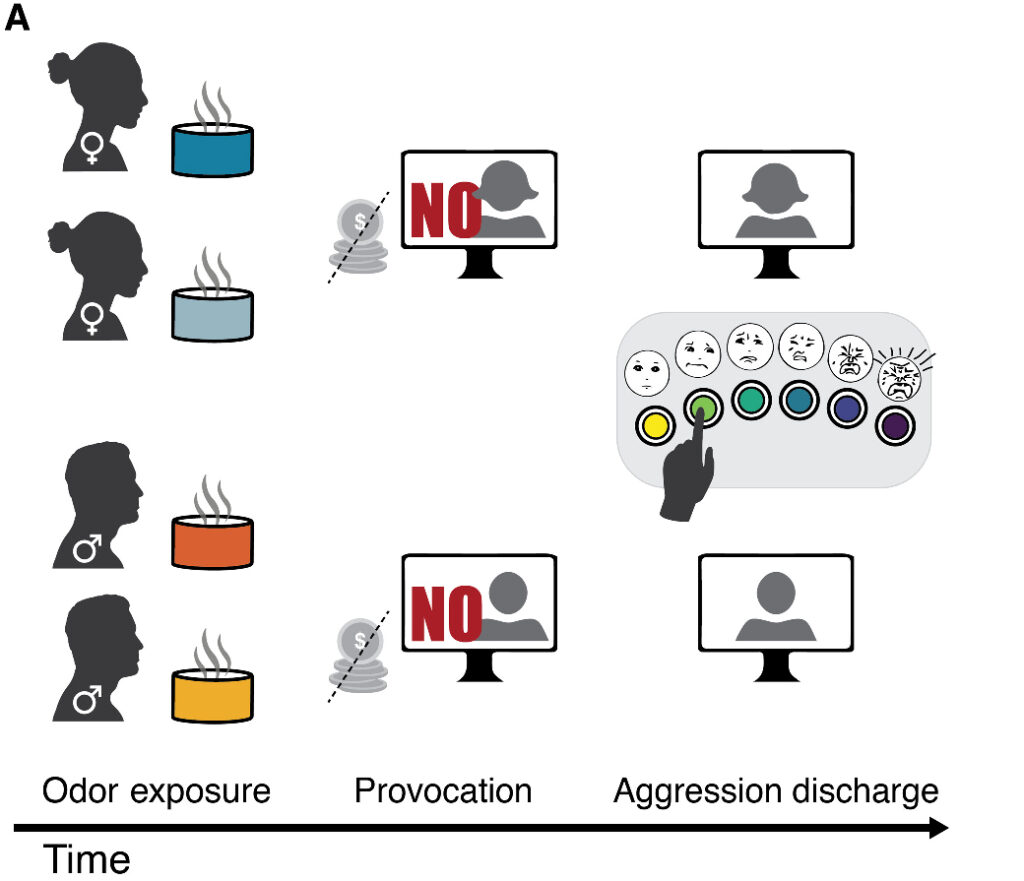
In the double-blind study, half of the participants inhaled HEX while the other half inhaled a placebo. They then played the ultimatum game with a purported partner. The partner in reality was an algorithm that only accepts offers that heavily discriminates against the participant. This step in the experiment was designed to provoke the participants so that their level of aggression could be measured.


In the ultimatum game, the first player is given a sum of money. The first player is then asked to split the money with another player, but there's a catch. Once Player 1 decides how much to give over and communicates the offer, Player 2 decides whether to accept or reject the offer. If Player 2 accepts, they both get the money as per the proposal. If player 2 rejects, both of them get nothing.
In the next stage of the experiment, the participant played another game with (they were told) the same fictitious partner. To win the game, the participant had to complete a shape identification task before their opponent. Each time the participant won, they had an opportunity to blast the “opponent” with a loud noise.
Crucially, the participants chose the volume of the noise blast, ranging from feeblest to loudest. The volume of the noise blast was considered a measure of aggression.
Different effects on men and women
Women who were exposed to HEX were more aggressive compared to women who inhaled the placebo. These women were more likely to retaliate with a noise blast of a higher volume on average. Men who were exposed to HEX, in stark contrast, were less aggressive compared to men who got the placebo.
“Women exposed to the chemical behaved 19% more aggressively in the noise-blast task, whereas men were 18.5% less aggressive.”
–Report by Emily Underrwood
HEX modulates connectivity in brain networks
To understand the effects of HEX on the brain, researchers did a companion study using brain-imaging. They discovered that HEX modified how one part of the brain, the angular gyrus, talked to other parts of the brain. This too was sex-dependent.
In men, HEX increased the connectivity between the angular gyrus and parts of the brain associated with aggression – the right temporal pole, the left amygdala, and bilateral lateral orbitofrontal cortex. In women, it reduced connectivity between the angular gyrus and these regions. The angular gyrus is believed to play a significant role in the perception of social cues.
“In humans, like in rodents, a “social odor” activates the “social brain.” Moreover, HEX modulated functional connectivity between these substrates of social appraisal (AG) and a network previously associated with aggression.”
Findings of the study suggest that HEX block aggression in male recipients while facilitating aggression in female recipients. This has led the researchers who conducted the study to speculate that the most likely users of HEX are human infants.
HEX is one ingredient in the cocktail of volatiles released by babies. According to the researchers, human babies may be using HEX to reduce the male aggression directed at them while enhancing maternal aggression (usually directed at others, and often to protect the baby).
Read more about the study by Eva Mishor et al. here.