Sunny Side Science
  • Home
  • Request a Design
  • Blog
  • About
No Result
View All Result
Sunny Side Science
  • Home
  • Request a Design
  • Blog
  • About
No Result
View All Result
Sunny Side Science
No Result
View All Result

Sex differences in the pelvis are not uniquely human

May 15, 2025
0
Share on Twitter

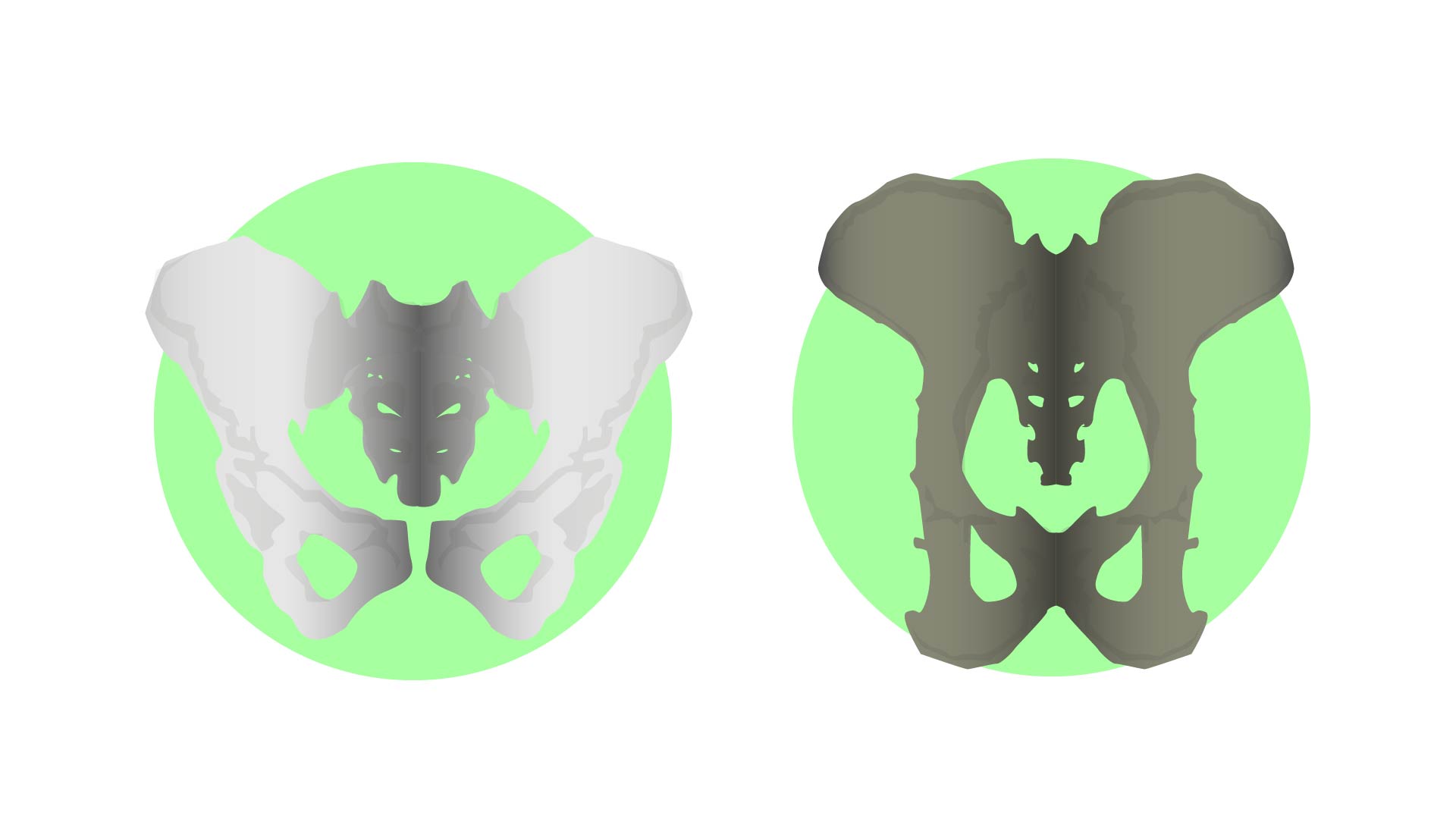
Wider hips in human females is a feature that has long been thought to have evolved to birth babies whose brains ballooned during the Pleistocene (about 2 million years ago). This phase in our evolutionary past, characterized by rapidly increasing brain size is called encephalization.

Now, a study by Barbara Fischer et al. has found that sex differences in the pelvis did not evolve during encephalization, but probably preceded it. The researchers compared the pelvic sex differences in humans with those in chimpanzees (whose lineage diverged from ours 4 million years ago). 44 anatomical 3D landmarks and 65 curve landmarks on each pelvis were used for the comparison. The sample comprised 34 adult chimpanzee pelves (20 female, 14 male) and 99 adult human pelves (53 female, 46 male).

The researchers found that the two species share the same pattern of sex differences in pelvis shape even though the magnitude of sex differences was two times larger in humans than in chimpanzees (explained by the fact that humans are much bigger than chimpanzees). The researchers also compared the sex differences in pelvic inlet size, which determines the dimensions of the birth canal. The inlet size was found to be 11% larger in human females and 10% larger in chimpanzee females (compared with males), yielding, once again, identical patterns of sex difference.


You might also like

Being in a Crowd During Exciting Events Bond People Through “Identity Fusion”

Being in a Crowd During Exciting Events Bond People Through “Identity Fusion”

May 15, 2025
Caffeine as a Supplement Boosts Athletic Performance

Caffeine as a Supplement Boosts Athletic Performance

May 15, 2025

So, why should sex differences in two species that supposedly faced different selection pressures be identical? The researchers think that the most parsimonious explanation is that the sex difference in anatomy existed in the common ancestor of chimpanzees and humans. Developmentally, pelvic sex differences come about due to hormone-induced remodeling of bones during puberty. The researchers go on to propose that relevant aspects of the endocrine system (and underlying genetic machinery) remain conserved since the common ancestor of all primates. What did evolve separately in species, they say, is the duration and amount of hormones released during puberty, producing species-specific magnitudes of sex difference in pelvic size.

Read more about the study here.

Next Post

People are surprisingly good at reading mental states from the eyes

Recommended

Restricting meals to daytime may reduce diabetes risk in night shift workers

Restricting meals to daytime may reduce diabetes risk in night shift workers

May 15, 2025
Chimps, like humans, show signs of uncertainty when faced with a hard choice

Chimps, like humans, show signs of uncertainty when faced with a hard choice

April 29, 2025
Wearing a proper mask can keep the risk of infection below 1%, even after an hour of exposure

Wearing a proper mask can keep the risk of infection below 1%, even after an hour of exposure

May 15, 2025
Latest estimate of psychopathy in the general population

Latest estimate of psychopathy in the general population

May 15, 2025

Popular Story

  • Restricting meals to daytime may reduce diabetes risk in night shift workers

    Restricting meals to daytime may reduce diabetes risk in night shift workers

    2989 shares
    Share 1195 Tweet 747
  • Chimps, like humans, show signs of uncertainty when faced with a hard choice

    2190 shares
    Share 875 Tweet 547
  • Wearing a proper mask can keep the risk of infection below 1%, even after an hour of exposure

    1448 shares
    Share 579 Tweet 362
  • Latest estimate of psychopathy in the general population

    1435 shares
    Share 574 Tweet 359
  • More than a third of children in the US don’t know how meat gets to the table

    1091 shares
    Share 436 Tweet 273
  • About

© 2026 Sunny Side Science - All rights reserved

No Result
View All Result
  • Home
  • Request a Design
  • Blog
  • About

© 2026 Sunny Side Science - All rights reserved